A special Night
Passover Seder and why this night is so special…
Passover is one of the most important Jewish holidays. It begins on the evening of the 14th of Nisan with the Passover Seder. In this blog post, we’ll briefly summarize what the holiday commemorates and what makes Seder so special.
During the communal Passover Seder, which is celebrated this year on April 1, we commemorate the liberation of the Israelites from Egyptian slavery. According to the Torah (Exodus 12), God commanded Moses to lead the people of Israel out of Egypt. However, the Egyptian pharaoh refused to let the people go, so God struck the Egyptians with ten plagues. The Israelites were spared; the plagues passed them by. Whether the name of the festival derives from the Hebrew word “פסח/pasah” (translated as “to pass over”) is disputed.
In remembrance of the exodus from Egypt, the Haggadah (Hebrew: הגדה, “telling”) is read on Passover Seder together with family or friends. The Haggadah describes not only the occasion of the festival—the liberation from slavery—but also the exact sequence of the festivities. For example, part of the festive preparations involves cleaning the home and removing so-called “chametz.” Chametz includes, for instance, grains that can ferment. During Passover, only unleavened bread may be eaten in remembrance of the Israelites’ hasty flight from Egypt. Matzah are very thin flatbreads made from flour and water that must be prepared within 18 minutes—that is, from mixing the flour to baking. From the Seder evening, which marks the beginning of Passover, until the end of the festival on the 8th day after it begins (in the Diaspora), only unleavened bread is eaten. Only after the festival ends do leavened bread and other grain products, such as pasta, cereal, or pastries, return to the menu.
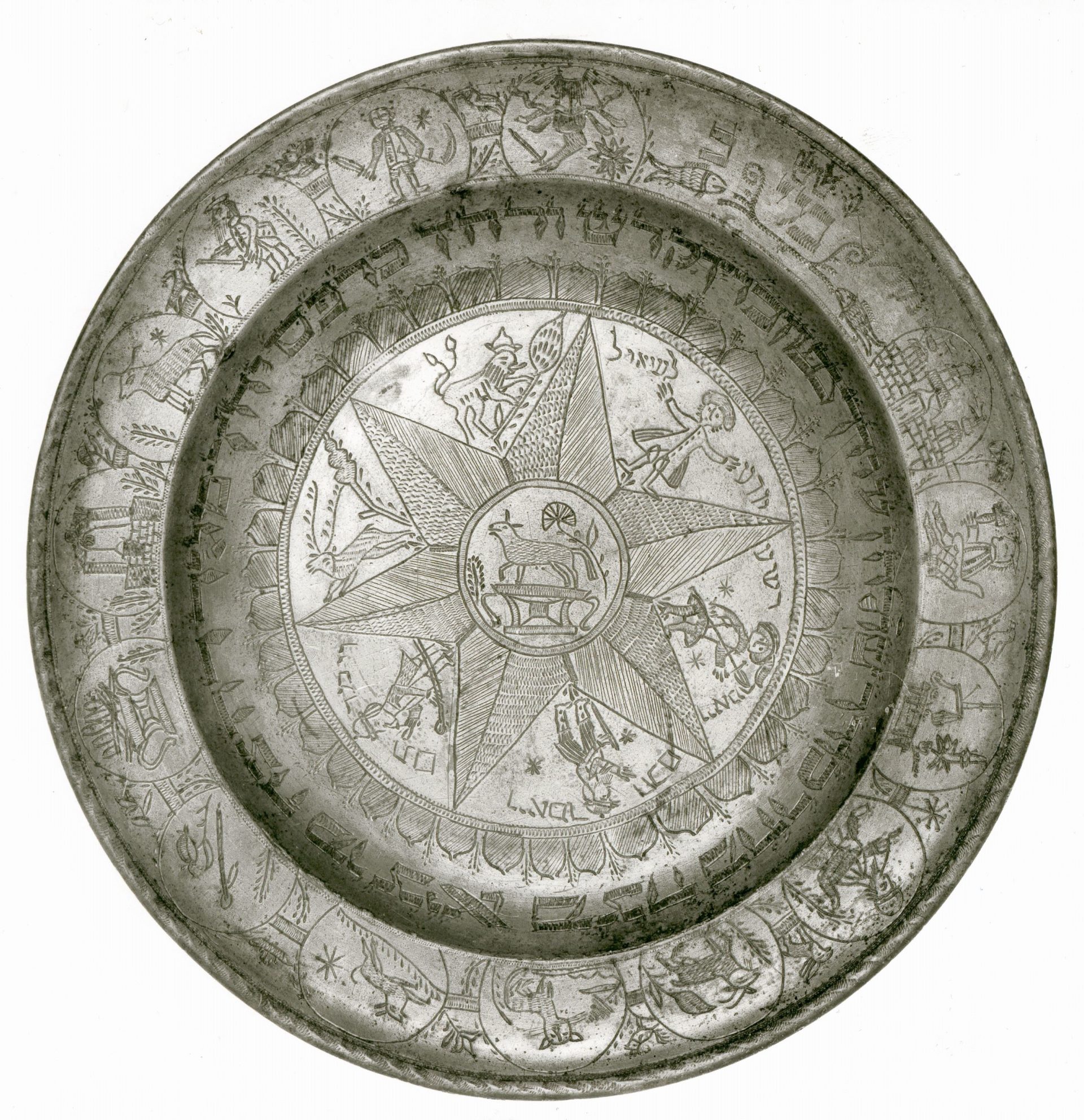
The Seder plate was made in England in 1743 and is part of the collection of the JMAS as a permanent loan from the Bavarian National Museum. © Bavarian National Museum
On Passover Seder, a special plate is used on which symbolic foods are arranged. The foods are eaten in a specific order (Hebrew: seder) . Each food represents a specific aspect of the story of the flight from Egypt, including:
- Maror – bitter herbs, e.g., horseradish; a symbol of bitterness / a reminder of slavery in Egypt
- Charoset – fruit paste, symbolizing the clay with which the Israelites had to form bricks while in slavery
- Serora – roasted lamb or chicken bone, intended to recall the Passover lamb sacrificed in the Temple
- Beitzah – an egg, as a reminder of the sacrifice offered on the holiday
- Karpas – e.g., celery, a reminder of the grueling labor; the vegetable is dipped in salt water as a reminder of the tears shed during slavery
Another important part of the Seder evening are four special questions. These are usually asked by the youngest person at the table, often the children of the family. The youngest child begins by asking, “What makes this night different from all other nights?”
“Why is this night different from all other nights—
For on all other nights we eat leavened and unleavened bread, but on this night only unleavened bread;
On all other nights we eat various kinds of herbs, but on this night only bitter ones,
on all other nights we do not dip a single herb, but on this night we dip twice,
on all other nights we sit upright or reclined, but on this night only reclined?”
Die Pessach Haggadah, Hentrich & Hentrich 2013
All of these are rituals that commemorate the liberation of the Israelites from Egyptian slavery.
Furthermore, celebrating the festival itself and reading from the Haggadah fulfill a biblical commandment, for it is written: “You shall observe this day as a memorial. Celebrate it as a festival to the Lord! It shall be a perpetual statute for your generations to come to celebrate this festival!” (Exodus 12:14).
With this in mind, we wish everyone celebrating a happy Passover!
April 2026